
The Phenomena Podcast:
Episode 1: Healing Beyond Belief
Listen Now
This episode of Phenomena explores energy healing by featuring breast cancer patient Mojdeh, whose tumor was found "not attached to any tissue" after daily work with healer John Lavack. This is followed by rigorous MD Anderson Cancer Center research, which found biofield therapy significantly reduces the growth and spread of pancreatic cancer cells. The episode advocates for a "both/and" approach to healing.
Listen on your favorite podcast platform



Join the Community
For exclusive access to the latest research, resources and stories transforming how we experience healing.
Transcript:
COLD OPEN
MUSIC: UP & UNDER
Mojdeh: After the surgery, my surgeon said, “I’ve never seen a tumor that is just sitting somewhere and not attached to any tissue.” And that’s exactly what John said. Like, okay, you’ve learned enough, your body let go. And that was amazing.
SERIES INTRODUCTION
Ivy: We are in a time of convergence. For most of human history, various forms of what’s now called energy healing have been utilized across different cultures to ease suffering and promote health and well-being. But the advent of modern medicine and science pushed these practices to the side. If we can’t measure it, it doesn’t exist, right? And stories of energy healing became just that—stories.
But right now, all of this is changing. It is coming together with new research, new understanding, and new possibilities.
I’m Ivy Ross and, as a design and business leader for global brands, a New York Times bestselling author, and an artist with work in museums around the world, my life has always been about navigating these two worlds—the solid ground of hard data and the undeniable power of the invisible.
At heart, I’m a child of wonder. I’m curious about the forces that connect us all. And so I invite you to join me as I explore this new frontier in medicine and healing. With astonishing stories. With irrefutable science. And with an open mind and heart.
This is Phenomena—The Science and Stories of Energy Healing.
MUSIC: ENDS
EPISODE INTRODUCTION
Ivy: For our first episode, we’re going to start big. If you’ve heard of energy healing—practices like Reiki, external qigong,and the like—you probably assume they might work for issues like pain management, mental health and stress…things you might think of as difficult but maybe not immediately life-threatening.
But what if I told you that, recently, tier one research institutions have been quietly studying the possibility of energy healing having a real, measurable impact on one of the leading causes of death in the U.S. and the world—cancer.
We’re going to hear from doctors and researchers at the MD Anderson Cancer Center, one of the world’s most respected cancer hospitals and research institutionslargest cancer care center in the world, about their remarkable findings what they found when they invited energy healers into the research lab to work with pancreatic cancer in cells and in mice.
Like I said…we’re starting big. But before we go big, we have to go small,with one woman’s story that starts with chronic pain in her left shoulder. Meet Mojdeh Stone.
ACT 1: Opening and Emotional Hook:
The “Experiencer” Personal Story
Mojdeh: “My name is Mojdeh. Mojdeh means good news in Persian. [Laughs]”
Ivy: Mojdeh is a cheerful woman with bushy black hair and a kind smile that always reaches up into her eyes. In 2013, Mojdeh received a diagnosis no one wants to hear but too many of us do…she had breast cancer.
Mojdeh: “It was actually found very conventionally. My annual mammogram, I got a call that something is unusual about it. And this was a Friday afternoon. And then on the phone call, I scheduled a Monday morning mammogram as well…I didn’t wanna wait. So Monday morning at eight o’clock I go there to do another mammogram, and they see exactly what they saw on Friday. And they go OK let’s do a 3D, let’s do an ultrasound. Everything kept showing the same mass. Also right there, they did a biopsy.
And at one point the doctor leaves the room and I said to the nurse, “This is cancer, but you just wanna make sure.” She said, “Didn’t hear it from me! But yes, we both think what we see has all the marks.
Three days later they call me in and they say, yeah, now it’s confirmed. It’s a very foggy thing to one day feel great. You come back from the gym and another day that you get that and you’re still perfect. I mean, nothing has changed.”
Ivy: Like most who get a diagnosis, Mojdeh began what’s commonly described as the runaway train of cancer treatment. It all starts happening…fast. The appointments, the scans, the treatments. It’s an all-hands-on-deck approach that can feel overwhelming.
Mojdeh: “They wanted to do like biopsy assisted MRI, to just make sure they know exactly where this thing is. That was really the most difficult part. Because an MRI to me is scary enough, let alone something like a knitting needle goes into you and it comes out. Anyway. But it’s just to make sure what they thought they saw, they saw really.”
Ivy: And what they saw was a standard fairly normal 4-centimeter tumor. Mojdeh scheduled a surgery to have it removed six weeks later and, in the meantime, kept her diagnosis to just a small inner circle, not even telling her mother at the time because of her family’s difficult history with cancer.
Mojdeh: “My sister had had it maybe eight years before I did. And her journey was really difficult, many doctors giving her the totally doomsday scenario. And my first reaction was, oh my God, my mother cannot go through this again. It wasn’t more about me. I was like, I can handle this, but my poor mom and watching her deal not so well with my sister, I was like, oh this poor woman. Now she’s gonna do that again, you know? That’s all I could think about.
I didn’t tell anybody. Only my son, my sister, my husband, knew, because I didn’t want anybody’s terrible story. I was on a path of healing. I didn’t want anybody to say, “My neighbor had it, you know, she died.” You know, I just didn’t want anybody to have any stories at all.
I wanted my story. I wanted to only be surrounded by people that it’s their job to heal me. I put myself in a bubble of healing. And I wanted John on my team because I was so successful with the shoulder pain that I had that never came back.”
Ivy: In addition to all of the nurses, doctors, oncologists, lab technicians, and other dedicated healthcare professionals treating Mojdeh for her cancer, she wanted to add just one more person to her healing team—John Lavack, an energy healer.
Mojdeh had met John years before at a personal growth workshop. At the time, she’d been suffering for years from chronic pain caused by what she calls a frozen shoulder, and during a break she and John struck up an unusual conversation.
Mojdeh: He said, "You know, you’re holding your left shoulder a little lower than your right shoulder. You must hurt a lot." I’m like, oh my God, yes it does. And how did you know?
I had a frozen shoulder that came back every year like clockwork in January. Physical therapy and cortisone would kind of calm it down and then it would come back. He said, "We could talk on the phone and get into why it hurts."
So two, three sessions on the phone and my shoulder has never had the same problem.”
Ivy: John’s treatment of Mojdeh for her chronic shoulder pain is truly fascinating, involving visualizations of Mojdeh letting go of past generations’ demands of her. You can listen to that part of the story on our website at phenomenahealing.com. But right now I want to get back to Mojdeh’s cancer story.
Because John had helped her solve this seemingly unsolvable issue of chronic pain—which never came back even years after their conversations—he was one of the first people she called after her cancer diagnosis.
Mojdeh: “He said, "Let’s work on this together but I want you to also learn this because it will empower you to heal yourself as well." So every day John and I talked about 20 minutes before my surgery, probably four or five weeks.
He directed my attention to: let’s learn from this. Your body is telling you something. Why? Again, this was on the left side. Why did you grow a tumor on top of your heart? We needed to learn from this.
…you need to learn from what your body is telling you. It started whispering and now it’s shouting at you. You need to listen."
Ivy: John was telling her: your shoulder pain before, that was the whisper. Now the cancer is shouting at you from the same place. It’s all on your left side. This means something.
I wanted to know more about John. What he does and how he does it. So we sat down with him on a call.
John: “My name is John Lavack and now I am doing what I call intuitive resonance healing work for a living.”
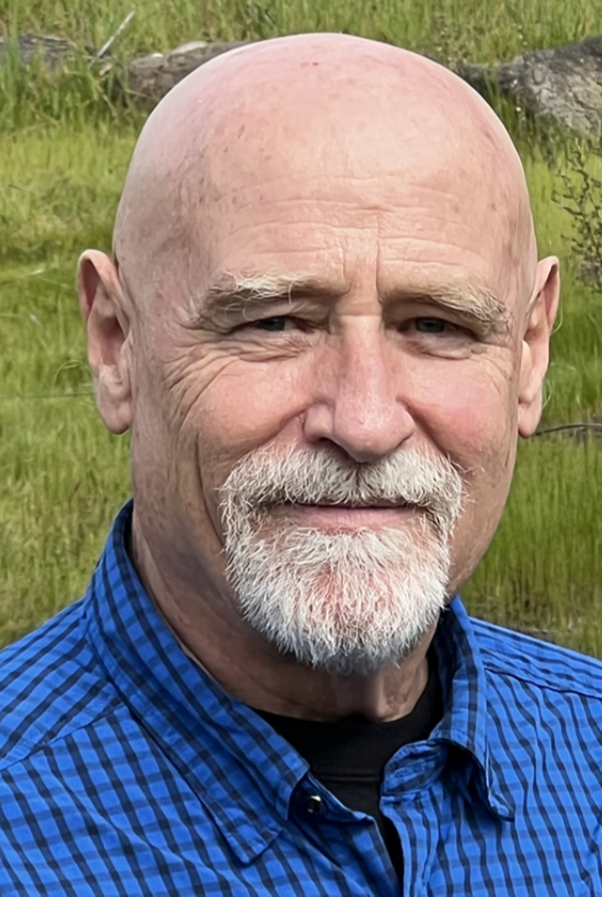
Ivy: John has rectangular glasses, a snow-white goatee, and shaved head, which he says only happened because of all the research he’s been involved with. After so many times shaving it to attach electrodes and monitor his brain functions, he decided to keep it shaved.
But John hasn’t always considered himself to be a full-time energy healer.
John: “I had a different career for a long time. I flew helicopters for 35 years. Part of why I flew helicopters for so long is I specialized in flying where I was the only one in the cockpit. I’d fly sling loads and do that kind of thing so I didn’t have people around me and I wasn’t picking up their energy.
It probably felt more like a little bit of a curse because you really want to fit in, you want to be normal. And not normal in that sense—I don’t fit in with whatever the norm is.”
Ivy: John has been involved with research projects for years, including four and a half years with MD Anderson Cancer Center, which I mentioned earlier and which we’ll get back to shortly. But first, let’s understand what he actually does.
John: “It’s 42 or 46 countries now I’ve worked with people. Lately it’s been more with diseases, but lots of folks with different kinds of cancers that seem to work for varying degrees with all kinds of cancers.”
Ivy: John practices different what are called “modalities” of energy healing. Most prominently, he prefers to work in distance healing, which means he can work with someone who isn’t in the same room with him or even in the same country. He can create a connection simply by speaking on the phone or just focusing on the person.
With Mojdeh’s cancer, John employed another modality, what’s called the Bengston Cycling Method. And, if you’re like me, it is nothing like what you might imagine when you think of energy healing. There are no crystals, no waving hands over the body. What he and his clients do is think of positive futures. I’ll let John explain.
John: “Basically it’s rapidly going through positive futures, cycling through them—that’s why it’s called cycling—but going rapidly through futures that I really want. Like I say, things that I really want in ways that I’ll know that I have them and the feeling of that, but rapidly going through that. And it creates a sensation or resonant field that healing happens in.
And that way you’re connecting with futures that you really want and then you’re gonna let those futures pull you to them as you’re getting in the frequency, your energy for them. And that’s basically all healing.
It’s as natural as breathing. It’s not like I’m having to consciously do it anymore. It is just as natural as walking. You don’t think about walking when you go out for a walk. You’re not really thinking about the walking. You just get up and do it. Same with the cycling. You’re just doing it almost as naturally as breathing after you practice for a while.”
Ivy: I have to admit, when I first heard this, I thought: how in the world does cycling through positive futures help heal cancer? But as we’ll hear later in the show, there’s something fascinating happening here about consciousness and the body’s ability to heal itself.
So Mojdeh and John worked together every day for about 20 minutes, for weeks leading up to her surgery. Not in the hope that he would completely cure her cancer, but as an act of agency.
And even though Mojdeh wasn’t looking for a miracle, something miraculous did in fact happen. Or at the very least, something entirely unexplainable.
Mojdeh: ”When I was talking to John, my daily routine, one night I told him I felt a dagger went into my left side and John said, you know, the tumor just let go because you have learned from this experience as much as possible.
You’ve paid it attention and you’ve learned everything you needed to learn from it, and now it could let go of your body. And I go, well, that’s cute. [laughs] Okay. You know so maybe it was just like, yeah, indigestion. I don’t know maybe. But when I talk to John, I always feel energy going through my left side anyway. But that was very different. It was very directed. It really felt like a dagger. ”
Ivy: Mojdeh didn’t realize just how miraculous this moment was, however, until the day of her surgery.
Mojdeh: “I remember it was cold and it was December. And I remember, there were two surgeons there. They were complaining, who chose Christmas music? It’s too early!
I met the anesthesiologist. I saw the other surgeons. Everybody said, hello, you know, it was really nice. Before going home, the surgeon came by and she’s like, you know I have never seen this before, but it was not attached to your body at all. But we took it out.
I’ve never seen a tumor that is just sitting somewhere and not attached to any tissue. She just had to pick it out. And that’s exactly what John said. Like, okay, you’ve learned enough, your body let go. And that was amazing.”
Ivy: Mojdeh’s surgeon told her that she saw something she couldn’t explain and had never seen before. The tumor, which on multiple scans and biopsies had seemed perfectly normal, wasn’t attached to any tissue in Mojdeh’s body. As John put it—it seemed like her body had simply let go. And that the stabbing sensation Mojdeh had felt was that moment of letting go.
After hearing this, I wanted to understand…how rare is this? What does it mean for a tumor to be found detached like this? So I reached out to Dr. Wayne Jonas, a family MD and renowned expert on integrative health and, more specifically, cancer.
Wayne: To say that a tumor isn’t attached, that’s very rare. Cancer cells are like any other living thing—they need nutrients to stay alive and to grow.
In the breast specifically, cancer cells are surrounded by fatty tissue that is, unfortunately, an excellent energy source and metabolic driver for cancer development and progression. In fact, breast cancer cells can stimulate adjacent fat cells to release lipids that provide fuel for cancer growth and secrete growth factors and hormones that actively promote cancer progression.
So a tumor in the breast that is just sitting there, not connected to any of this nutrient source…how did it develop at all? It seems like it must have been connected at some point just to exist and then, for some reason, it wasn’t.
MUSIC: UP & UNDER
Ivy: How could simply imagining good things have done this? How could intention and consciousness be working at a level we just don’t understand? And how could someone like John seemingly channel energy into someone else’s body to heal it…these are some of the questions I’m left with.
And as you’ll hear in the second part of our story, John has been participating in groundbreaking scientific studies to answer just those kinds of questions about energy healing…and cancer.
And that’s where Dr. Lorenzo Cohen comes in. After this.
MUSIC: FADE
< BREAK >
ACT 2: Scientific Commentary:
MD Anderson and Measurable Effects
Ivy: Whenever I talk with someone about energy healing, it doesn’t take long for the conversation to break down into the binary of belief or disbelief. You either buy it or you don’t.
But as a friend and researcherexpert recently told me: “Belief isn’t a binary. It’s a spectrum.” When we treat it like a light switch—it’s on or it’s off—belief becomes brittle and positions harden in defense.
But when we understand that belief is a spectrum, we’re more able to incorporate new information. We have a greater capacity for understanding and growth.
The researcher and friend I mentioned who opened my eyes to this is Meredith Sprengel, Research and Program Director for the Subtle Energy Funders Collective. We’ll check in with her a bit later to help make sense of some of the research we’re about to hear.
But first, I want you to meet Dr. Lorenzo Cohen.
Lorenzo: “My name’s Lorenzo Cohen. I’m the director of the Integrative Medicine program at MD Anderson Cancer Center in Houston, Texas.”
Ivy: MD Anderson is one of the largest and most respected cancer care centers in the world. And for the past several years, Dr. Cohen and his team have been doing something remarkable: bringing healers like John into the laboratory to observe and measure the effects of energy healing modalities on one of the deadliest and most destructive illnesses in our world today—pancreatic cancer.
Before we get to what they found, I think it’s important to understand why this kind of research is happening. A major research institution doesn’t just decide to study energy healing on a whim. There has to be a compelling reason.
I’ll let Lorenzo explain.
Lorenzo: “One of the driving forces for me that allowed me to do this regardless of the support and the questioning from my colleagues is that the patients were utilizing these modalities, whether that was for quality of life or—in one case, a husband of a patient from the San Francisco Bay area emailed me saying, "Is there any evidence that external Qigong works? Because my wife with stage one curable breast cancer is foregoing conventional medicine and she’s just going to a Qigong healer.
And that’s what actually drove us to do the first study. Because the answer to him was, there actually isn’t evidence that it doesn’t work because those studies haven’t been done. And if there’s anything out there, it would suggest that maybe it would work but it’s more anecdotal and nothing systematic in nature.
So as a leader of integrative oncology, it’s really incumbent upon me and us as a field to do the research on the things that, at a minimum, that we think are gonna be useful and also that patients are doing and they think work, to show whether it does or not.”
Ivy: To me, that’s a scientist’s answer, and I love it. Not dismissing out of hand but admitting—you know what? We don’t know it doesn’t work. We should know.
I’ve always thought creative people and scientists react to the unknown in a similar way. We’re curious. Comfortable with the questions. In fact, we kind of love them.
So what are the questions here? Can we observe anything actually happening here? If so, can we measure it? Can we prove one way or another if energy healing, in a word, works—in a laboratory setting, with rigorous controls and scientific methods. Does. It. Work. And if it does, can we measure it? Can we understand why it’s happening, how it’s happening?
These are the kinds of questions Lorenzo and his team set out to answer. Here he is describing the tests they conducted with John and other healers.
Lorenzo: “If you walked in when we were doing one of the experiments, you would see a person sitting at the bench. If we were measuring EEG, they would have an EEG cap on, but that was only in certain experiments. And they would be, you know, leaning towards, sometimes putting their hands near but never touching, either petri dishes that have cancer cells in them, or two cages of animals.
Each experiment, after lots of work, lasts about 15 minutes. So it’s a relatively quick treatment.”
Ivy: So picture this: a healer sitting in front of Petri dishes filled with pancreatic cancer cells. Hands hovering but never touching. And the healer is doing... well, whatever it is they do. In John’s case, cycling through positive futures. For 15 minutes. Then they put the petri dishes back and look at the results.
But here’s what makes this rigorous science: they had control groups.
Lorenzo: “In all of the studies, we always had what we called sham controls. Some of the cells were on the bench or animals in front of the biofield therapists, and similarly, we would have cells or animals on the bench in front of a sham person who mimicked the movements, the distance, the heat—we emit heat as living organisms. So all that would be controlled.
In addition, because we went into this work somewhat skeptical, we had what we call incubator controls or colony controls where the cells and the animals never came out.”
Ivy: One note: Lorenzo uses the term “biofield therapists.” That is another term for energy healers. Biofield simply means a field of electromagnetic and subtle energy that surrounds and permeates the human body.
And with definitions like that popping up, now is a good time to point out that I’m no scientist. And while I do think there’s a similarity in how creative people like me and scientists like Lorenzo ask questions, the answers to those questions are a whole other story.
So I brought in my friend and research expert Meredith to help out. Meredith has spent the last ten years working in the fields of integrative medicine and biofield science with the Samueli Institute, The John W. Brick Mental Health Foundation, and The Netherlands Organisation for Applied Scientific Research. Meredith, welcome.
Meredith: Hello.
Ivy: So three groups: cells getting real healing energy, cells in front of someone who’s pretending—which I find to be kind of funny…how do I get that gig?
Meredith: [responds, e.g., “Right?]
Ivy: And the third group are cells that stayed in the incubator the whole time, or the animals that never entered the lab. Explain that to me.
Meredith: Sure, so just leaving that third group in the incubator or the animals in their colonies in another part of the building means their conditions don’t change. Which is crucial because the temperature difference between the incubators and what we’d call the bench—where the experiment takes place in the lab—it’s a difference of like 30 to 40 degrees. That can obviously have an effect on them, so they want to have a control for that. Same for the animals. Moving them, interacting with them, all of that can have an impact that you want to account for.
Ivy: That makes sense. And why testing cells and animals both? That seems like a lot.
Meredith: Both of those are really to cut down on or, in the case of the petri dishes, completely eliminate the possibility of a placebo effect.
Ivy: That’s when people expectthink something’s going to helphelping them so it does in fact help them.
Meredith: Exactly.
Ivy: We’re actually going to explore the placebo effect more in a later episode because it’s fascinating how far that can go.
Meredith: Right. But here, they take it down to lab animals as subjects and even to pancreatic cancer cells in a petri dishes. So there’s no possibility of mind over matter.
Ivy: Now before we get to the results, I think it’s necessary to take a step back and ask a different question. A basic question. What is cancer? Here’s Lorenzo.
Lorenzo: “Cancer by definition is uncontrolled cell growth. One of the hallmarks of cancer is the ability of a tumor cell to leave the primary organ and go to another part of the body and colonize, and we call that metastasis. Cells are not supposed to do that. A normal cell, when it leaves the breast, it will die. It’ll undergo apoptosis. But cancer cells release a number of different products to allow that process to happen.
So that’s critically important because what kills people is not the primary tumor that can be excised out. It’s the metastatic disease. Once it gets out of the primary organ and starts colonizing in another part of the body, that is typically the cause of death for cancer patients.”
Ivy: Cancer, at its core, is uncontrolled cell growth. And its lethality comes from spreading. So ideally, these experiments would determine if energy healing could somehow slow this all down.
Meredith: Exactly. People talk about “the cure for cancer” but what a lot of research and investment is aimed at is slowing it down. If we can slow the growth down, interrupt the metastasis, that is enormously beneficial for patients. Slowing things down gives us time—time for new clinical trials, time for more treatments, time for patients to simply live more life, and sometimes time enough to make cancer a chronic but liveable condition.
Ivy: Instead of something that felt like a death sentence to so many people.
Meredith: Yes, exactly.
Ivy: And this is where the results of Lorenzo and his team are truly amazing.
Lorenzo: “So are the cells treated by biofield replicating at a slower rate? Is there less growth? And the answer is yes. Compared to the sham controls and incubator controls, there’s more than a doubling of reduction in cell growth with biofield therapy.
Ivy: Lorenzo says this like it’s any other fact but it is worth repeating—more than a doubling of reduction in cell growth. Let that sink in for a moment. Cancer cells that got biofield healing grew significantly slower than cancer cells that didn’t.
Lorenzo: “We’ve been able to replicate—again with multiple therapists, with multiple pancreatic cell lines—that biofield therapy decreases the invasiveness of the pancreatic cancer, as well as the ability to migrate over distances. It slows the whole process down.”
We can go deeper into the cells now that we understand some of the fundamental process of turning a primary cancer to become more metastatic in nature. And we can go down and look at some of the driving proteins and genes.
And we’ve clearly shown that the gene regulatory pathways that are linked with this whole process of becoming metastatic were all activated, let’s say, or deactivated as the case may be, with the biofield therapy decreasing the metastatic potential at the genetic level, at the gene level.”
Meredith: He’s saying they could see changes in the genes themselves, which is like shutting off water for a leaky pipe at the source. And it’s also worth noting that the study wasit has been replicated across multiple therapists, which any valid study is going to do.
Ivy: And to me that means—while John is truly a rockstar of a healer—it’s not just him. Even iIf we accept that it is happening, it’s not happening just because John or someone like him has unique special powers.
Meredith: Right. It’s not just one gifted healer. It can be reproduced, maybe even learned or taught. That’s the difference between magic and medicine. Magic is unrepeatable. Medicine is something you can prescribe again and again, and know that it will work. Medicine is repeatable.
Ivy: For Lorenzo and his team and all the other researchers doing work in this field—and there are many of them now—they know this is just a first step. And even this first step is a hard one.
Meredith: Yeah, as curious and open and inquisitive as the scientific community can be, it can still also be incredibly difficult for anyone to go against the orthodoxy. It takes time to change course with things like this.
Ivy: Even Lorenzo—the man whose team is doing the research and who very much believes in the data his studies are producing—balances these new findings with a healthy skepticism and an awareness of the reality of trying to shift paradigms.
Lorenzo: “I still remain skeptical even though I see it with my own eyes because I don’t understand what they’re doing.
Until we have the mechanism, the field is gonna be questioned. As in fact have all real scientific revolutions.
Galileo was dismissed until it was understood. Dr. Semmelweis discovered that if people delivering babies wash their hands before delivering the baby, it decreased the probability that the child would die and that the mother would die. He was summarily dismissed, drummed out of town, so to speak. And that was because we didn’t know about germs.
Once they discovered germs, then it’s like, well, of course you should wash your hands before you deliver a baby.
So the mechanism is key and we’re not quite there yet. But I am doing the research and believe exactly the data I’m seeing because that’s the hallmark of a good scientist.”
Ivy: “We’re not quite there yet.” But it certainly seems like we’re moving in a very interesting direction.
We’ll be right back.
MUSIC UP & UNDER
< BREAK >
ACT 3: Deepening belief and expanding the frame
Ivy: So we’ve heard the science. Dr. Cohen’s research at MD Anderson shows that biofield therapy can actually slow cancer’s ability to spread—measurable, repeatable results in the lab.
Now that we know something real is happening at the cellular level, I want to go back to Mojdeh’s story. Because here’s what I kept wondering: what does it actually feel like? Not the theory, not the petri dish—but the lived experience of choosing to work with an energy healer while facing cancer.
Let’s return to those weeks between Mojdeh’s diagnosis and her December surgery. What was actually happening in those daily sessions with John?
Mojdeh: “...I would like to just talk with him every day for a half an hour, just so that we’re, we’re working on this, Brings my attention to what I can do. The doctors do their thing. I’d like to also be a part of my healing…
As soon as John and I get on the phone, I feel energy going through my left arm. It feels like when your hand falls asleep. So it… it’s a tingling. I can’t explain it, but it doesn’t (hurt). It’s a tingling and it feels great.”
John: “ It’s more comfortable for me to work with somebody remotely than in person. …that’s not comfortable for me because in a way I’m holding you as too real. Whereas when I’m not seeing you, I’m seeing how you look like energetically, and then it’s holding what I call the energy space and I’m cycling, and then I’m also doing other things like saying, okay, where’s the energy shifting? What’s coming up and how can I help facilitate the change happening?
Mojdeh: “He said…again, it’s on your left side. Your feminine energy wants to come out. You’re blocking love from entering your life. I mean, he just brought it to a whole dimension that I didn’t understand.”
John: “...for me it’s a sensation mainly in my hands. But I’m getting information and a little bit of sensation. I try not to feel it in my body, but I’ll be sensing with my hands, getting auditory, there’s the visual component. So I’m getting multisensorially.
I really do try and avoid smelling and tasting. A lot of things don’t smell good or taste good in emotions and diseases. You hear “that left a bad taste in my mouth.” People say about a conversation or that stinks. People are, uh, sensing things.
That’s why I think pretty well everybody is capable of being more aware of the energy, it’s just socially, I don’t know, say bred out of us in a way.”
Ivy: This is what they did every day for twenty to thirty minutes. For weeks. But here’s the thing—Mojdeh wasn’t looking for a cure, not exactly.
Mojdeh: “I knew that this thing will not disappear. The more I talked to John, I knew that that was not the goal. The goal was to make the whole process what I call elegant. I was not looking for a miracle. I was really looking to get empowered personally to feel that I’m part of this solution.
I’m not a victim. I knew that just having that kind of assurance that I have more than one toolbox. In fact, my son was very worried like, “Mom, you still have to go to the doctor.” I’m like, “I am!”
Ivy: Mojdeh was always going to have surgery. She was always going to follow her oncologist’s recommendations. John wasn’t replacing her medical team—he was joining it.
Mojdeh: “He said, ’I’m not telling you you don’t need surgery. I’m not telling you you don’t need follow-up. But you need to learn from what your body is telling you.”
In my opinion, if we’re open to Western medicine and also understand that there are methods of healing—ancient and modern—that together could have the synergy of all these things together, I think is magic.
I think that it doesn’t mean that we don’t believe in modern medicine. But I think the synergy of all of these things together is the magic. You know, it’s not only one thing. It’s the sunshine and the clean air and the good food. Your health is not only one thing. And I think this is something that could very much be a formula for a lot of healing.”
John: “I realize that I—and I’m very aware of this—I don’t heal anybody. I help people to heal themselves. And even a brilliant surgeon doing a masterful surgery, that’s just helping the person to heal themselves, the body to heal, to enhance the healing. And if they don’t receive that surgery, then no matter how wonderful it is, it’s not gonna be successful. The same with any healing, whether you’re doing chemo or radiation or vitamins or any kind…any modality is only gonna work if the person or the being is able to receive it.”
Ivy: The question I’m left with after all of this is, simply, did energy healing do this? Was the tumor detached because of Mojdeh’s inner work to “learn what her body was telling her?”
But maybe that’s not the right question. Maybe the question is: why do we need it to be just one thing?
Mojdeh didn’t feel like she had to choose between two worlds—conventional treatment or energy healing. She chose both. She showed up as someone who respected Western medicine and also recognized that there was more available to her than just surgery and waiting.
There’s so much to unpack there. And to help me unpack it, I decided to invite Meredith back for another discussion.
ACT 4: Reflection and Close:
Connecting the Dots
Ivy: Meredith, thank you for sitting down with me again. I have to say—I keep coming back to that moment after Mojdeh’s surgery. Her surgeon saying, “I’ve never seen a tumor that is just sitting somewhere and not attached to any tissue.” That’s extraordinary.
Meredith: And that it’s exactly what John told her would happen. He said, “Your body has learned what it needed to learn. It’s time to let go.”
Ivy: What I’m trying to understand is: How do we connect that experience with Lorenzo’s research showing cancer cells growing at half the rate after biofield therapy?
Meredith: I think the honest answer is: we’re still figuring that out. What we can say is that Lorenzo’s research at MD Anderson was very rigorous, and it provides the best scientific evidence to date that shows that it appearsseems possible for energy healing may to have a measurable, physical effect on cancer at the cellular level, in controlled laboratory conditions, across multiple healers.
Ivy: More than a doubling of the reduction in cell growth.
Meredith: Right. So it appears we know something real is happening. And that what’s happening is beyond placebo effect, since we see it in cells and mice. We just don’t fully understand the mechanisms yet.
Ivy: Lorenzo talked about that—how until we understand the mechanism, this work is going to be questioned. He compared it to Semmelweis and the lack of hand-washing before we knew about germs.
Meredith: That’s actually a really helpful parallel. Semmelweis was right—hand-washing saved lives. But without the germ theory to explain why, the medical establishment dismissed him. Once we understood germs, it became obvious.
So then what’s the “germ theory” for biofield healing? What’s the unseen underlying explanation?
Ivy: And we don’t have that yet.
Meredith: No but we have clues. Lorenzo’s team found changes in gene expression—specific genes related to cell growth and death were being turned on or off. That’s not vague. That’s molecular biology.
Ivy: So even without understanding how it works, we can see what it does.
Meredith: Yes. And honestly, that’s where we are with a lot of medicine. We used aspirin for decades before we understood its mechanism. We still don’t fully understand how anesthesia works, but we use it every day because it’s effective.
Ivy: But here’s where I get stuck: How does John, sitting however many miles away, thinking about positive futures—how does that change what’s happening in Mojdeh’s cells? That seems impossible.
Meredith: It does seem impossible from our current framework. But think about what we’ve learned from physics in the last century. Quantum entanglement is a real thing—two particles connected across vast distances, where measuring one instantly affects the other. Einstein called it “spooky action at a distance,” and it’s real. It’s measurable.
Ivy: You’re saying human consciousness might work similarly?
Meredith: I’m saying we don’t know the limits of what consciousness can do. The biofield that Lorenzo studies—that field of electromagnetic energy around the body—we’re just beginning to understand how information might be transmitted through that. But quantum entanglement is something a lot of people in the field are interested in to connect the dots.
I’ll also say: John doesn’t claim to be healing Mojdeh. He said, “I don’t heal anybody. I help people heal themselves.”
Ivy: Right.
Meredith: Maybe that’s a key insight. Our entire medical system is built on a very mechanical view—the body is a machine, when something breaks, you fix it from the outside. Cut it out, poison it with chemotherapy, burn it with radiation.
But what if there’s an intelligence in the body that knows how to heal itself in some ways, and what energy healingbiofield therapy does is somehow support or amplify that process?
There is so much our bodies do that is below our awareness. Miraculous things. Lorenzo’s work shows that energy heaingbiofield therapy can affect the body’s own healing mechanisms—cell growth regulation, apoptosis, gene expression. Maybe the therapy is just enhancing those natural processes.
Ivy: So where does this leave us? If we accept that this is real—that energy healing produces measurable biological effects—what do we actually do with that information?
Meredith: I think we have to do two things at once. We need more research. Larger studies, more replication, better understanding of mechanisms. That’s how you move from intriguing findings to established medicine.
But we also can’t tell people like Mojdeh to wait until we understand everything perfectly. The evidence suggests this can help, and it’s not harmful when done alongside conventional treatment.
Ivy: Right. Mojdeh didn’t skip her surgery. She did both. And maybe that’s the real shift here—moving from either/or thinking to both/and. Mojdeh said something beautiful about that—she talked about the “magic” of everything together. The surgery, the energy healing, good food, clean air, all of it working together.
Meredith: That’s a much more holistic view of healing. And I think that’s where medicine needs to go. Not replacing what works, but expanding our understanding of what’s possible.
Ivy: Meredith, I’m curious—where do you see this field heading in the next five, ten years?
Meredith: I’m actually optimistic. We’re at a moment when people are asking bigger questions about health and healing. And when you have institutions like MD Anderson doing this research, publishing these findings—that changes the conversation.
Will we understand the mechanism in five years? Maybe not completely. But I think we’ll see more integration of these practices into cancer centers, into hospitals. We’ll see more research funding. And critically, we’ll see more people having access to these approaches.
Ivy: So what would you say to someone listening who’s facing something serious—cancer, chronic illness—and wondering whether energy healing could help them?
Meredith: I’d say: don’t think of it as choosing between conventional medicine and energy healing. Think of it as expanding your options. Work with your doctors. Do the treatments that are proven to work. But also explore whether biofield therapy might support your body’s own healing process.
And be discerning. Find practitioners who are trained, who work in collaboration with medical care, who don’t make unrealistic promises.
Ivy: That feels like important guidance. Meredith, thank you so much for helping me think through all of this.
Meredith: My pleasure!
CLOSING
Ivy: As we come to the end of this first episode, I have to say…this already feels like a lot of information.
What I find refreshing is that—especially in today’s world of hot takes and everyone thinking they have the answer to everything—the people we heard from today all humbly accept that they might not have all those answers.
Mojdeh says it’s the synergy of everything together. John says he doesn’t heal anyone; he helps them heal themselves. Dr. Cohen says he believes his own data, even though he doesn’t fully understand the mechanism yet.
The question isn’t whether this is real—we have some compelling evidence that something’s happening. The question is what we do with that knowledge. How do we make it accessible? How do we integrate it into a healthcare system that desperately needs new approaches?
And maybe the biggest question: If there really is energy between us, if consciousness can influence healing, if we’re all connected through some kind of field—what else does that mean about who we are and what we’re capable of?
MUSIC: UP & UNDER
Ivy: Join me next time on Phenomena, when we’ll explore Reiki—one of the most well-known forms of energy healing. We’ll meet someone whose chronic pain was transformed through Reiki, and we’ll hear about a study from Harvard that compared Reiki with what they called Fakey—sham Reiki—with results that might surprise you.
Plus, we’ll explore that question of placebo effect. If belief can heal, does it matter whether the healing modality is “real” or not? That’s a bigger question than you might think.
You can learn more about energy healing at our website phenomenahealing.com, where you’ll find resources, that story of Mojdeh’s healing for her shoulder—which really is beautiful—links to the research we discussed, and information about the documentary series also called Phenomena.
If this episode moved you or challenged you, share it with someone. These conversations matter. We’re at the beginning of something—a new understanding of what healing can be. And the more people who engage with these questions, the faster we’ll find answers.
I’m Ivy Ross, and this has been Phenomena: The Science and Stories of Energy Healing. Thanks for listening.
MUSIC UP AND OUT
END OF EPISODE ONE

Phenomena Healing was created by the non-profit Merraki Media and the Subtle Energy Funders Collective to thoughtfully explore energy healing, using rigorous scientific inquiry, in an endeavor to help reduce suffering and promote wellbeing. "Merraki" is a Greek word that means “doing something purely for the love of it."
© 2026 Phenomena Healing